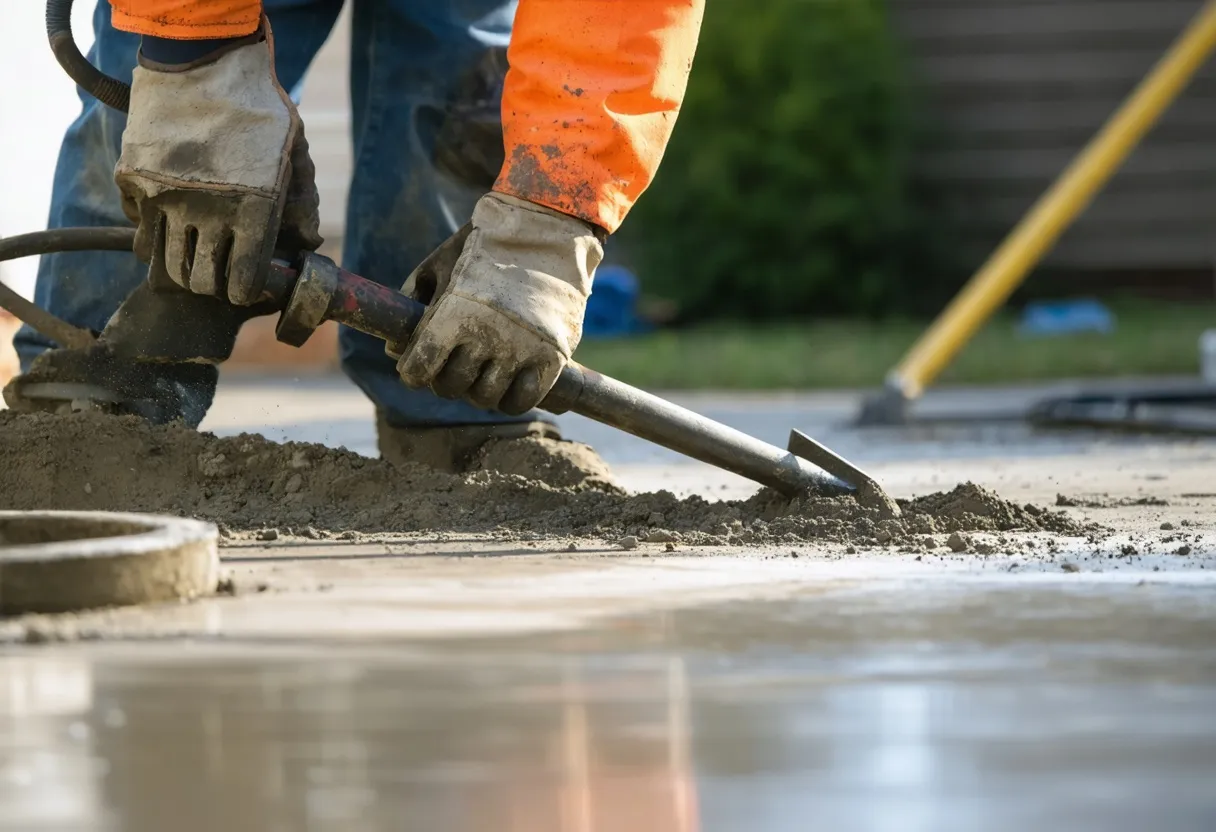
Typing “concrete FAQ Tuscaloosa AL” into a search bar usually means one of two things: you're staring at a quote that never actually explains what you're paying for, or you're trying to plan a driveway, patio, or repair and every article you find gives the same vague national advice about “pricing factors” without ever answering the question. This page is built differently. Every answer below is grounded in what actually happens to concrete poured into West Alabama's clay-heavy soil, under our roughly 55 inches of annual rainfall, in a climate that swings from summer thunderstorms to the occasional hard winter freeze.
The short version, before you read further: a concrete project in Tuscaloosa succeeds or fails on three things — subgrade preparation engineered for our expansive clay, correctly placed control joints, and pour timing that respects our heat, humidity, and storm patterns. We also believe a real quote should say so in writing, with a mix design, a reinforcement plan, and a warranty you can actually read — not a number pulled from a square-footage calculator. The FAQs below walk through the questions that matter most before you sign anything.
Concrete Curing Time and Pour Timing: Straight Answers for Alabama
How long does concrete actually take to cure in Tuscaloosa?
Most slabs are firm enough to walk on within 24 to 48 hours and can typically handle vehicle traffic around the one-week mark, but full structural cure — the point where concrete reaches its designed strength — takes about 28 days. Curing continues gradually even after that, which is why we ask homeowners to hold off on sealing, staining, or parking a boat trailer on a new slab until it's had adequate time. Heat and humidity speed up the surface-level set, but they don't shortcut the internal ch
Is there a bad season to pour concrete in Alabama?
No season is off the table here, but each one changes the process. Spring and fall give the most predictable curing window because temperatures stay moderate. Summer heat and Alabama's afternoon thunderstorm pattern often push pours to early morning and demand close attention to keeping the surface moist while it sets. Winter rarely brings extended hard freezes in Tuscaloosa, but an occasional freezing night can permanently damage concrete that hasn't reached sufficient strength yet, so cold-wea
How soon can I actually drive on new concrete?
Foot traffic is usually fine within a day or two, but vehicle weight is a different question — most driveways need roughly a week before regular car traffic, and longer before something heavier, like a loaded trailer or RV, sits on them. Pushing that timeline is one of the more common ways a new driveway ends up with permanent tire-track indentations or surface damage.
Does our clay soil and rainfall change the curing timeline?
It's worth separating two things homeowners often lump together. Curing is the chemical hardening of the concrete itself, and humidity affects that somewhat by slowing surface evaporation. Soil movement is a separate, longer-term issue — Tuscaloosa County's clay-heavy soil expands when it absorbs water and contracts as it dries, and if the subgrade underneath your slab wasn't compacted correctly before the pour, that movement is what causes cracking and heaving years down the road, not a curing-
Concrete vs. Cement, Explained (Because Your Quote Should Get This Right)
Almost everyone says “cement” when they mean “concrete,” and the mix-up isn't just semantic — it's often a clue about how carefully a contractor is planning your job. Cement is a manufactured powder, a binder made from heated and ground limestone and clay. On its own, it's an ingredient, not a building material. Concrete is what you actually get: cement mixed with water, sand, and coarse aggregate, poured, screeded, and finished into a slab. When you order a driveway or patio, you're ordering concrete — and the cement content in that mix, usually expressed as a PSI strength rating, determines how dense and crack-resistant the finished surface will be.
As a general benchmark, decorative walkways and patios are typically specified at a lower PSI than driveways or slabs that carry vehicle weight, which need a denser mix to resist cracking and abrasion over years of use. The right number for your project depends on what it needs to carry, which should be a conversation, not a default.
Why the Confusion Matters at the Quote Stage
A contractor who talks only about “pouring cement” without ever specifying a PSI rating, aggregate type, or reinforcement plan is often the same contractor who hasn't thought through subgrade prep either. Vague language on one part of a quote tends to travel with vague planning everywhere else. When you're comparing bids, ask directly what PSI mix is specified and why — a driveway carrying daily vehicle loads needs a different mix design than a decorative walkway, and a straight answer tells you the contractor is engineering your project rather than guessing at a square-footage number.
Clay Soil Changes the Calculation Here
In most of the country, mix design is the main variable. In Tuscaloosa, it's only half the equation. The expansive clay soil under neighborhoods like Forest Lake and Alberta City, and across the wider footprint into Northport, Cottondale, and Vance, moves with moisture — swelling when saturated and shrinking as it dries through our roughly 55-inch annual rainfall cycle. Concrete poured at the correct PSI over an improperly compacted subgrade will still crack, because the ground underneath it is moving. That's why an honest Tuscaloosa quote treats mix strength and subgrade engineering as two parts of the same answer, not two separate line items.
What a Trustworthy Tuscaloosa Concrete Quote Should Include
Getting New Concrete to Match What's Already on Your Property
Before matching anything, we look at how much the existing concrete has weathered, since sun exposure changes tone in ways new concrete hasn't experienced yet.
Broom, trowel, and stamped finishes each depend on the specific tools and technique originally used, so replicating the general texture isn't enough on its own.
Aggregate sourcing and cement batches change over time, which can create a subtle color difference between old and new concrete even with a comparable mix design.
Color additives and stains can bring a new section closer to the tone of older, weathered concrete, though they narrow the gap rather than erase it.
We tell you what's realistically achievable for your specific patch or extension during the consultation, rather than promising an exact match we can't guarantee.
A Warranty You Can Actually Read
Every project we quote comes with a written warranty that spells out exactly what's covered and what would void it — not a verbal assurance you have to take on faith. If a contractor won't put warranty terms in writing before you sign, that's worth asking about directly.
More Concrete Questions Tuscaloosa Homeowners Ask Before They Call
Should I try a concrete project myself, or is it worth hiring out?
Small decorative work — a stepping-stone path, patching a minor chip — is within reach for a motivated homeowner. Anything structural, like a driveway or patio, is a different calculation. Subgrade prep on our clay soil is difficult to get right without compaction equipment and soil experience, and mistakes don't show up until the slab starts moving months or years later. Concrete also starts setting within roughly 30 to 90 minutes depending on temperature, and that window shrinks fast in Alabam
Do you work in my specific neighborhood?
We work throughout Tuscaloosa, including Forest Lake and Alberta City, and across the wider market that includes Northport, Cottondale, and Vance. Soil and drainage conditions shift across that footprint — older neighborhoods with mature trees tend to need more attention to root intrusion, while newer construction on the outskirts often sits on heavily compacted fill dirt that needs different prep. The site consultation is where we account for your specific location rather than applying a one-si
If you don't publish flat prices, how do I know what drives my cost?
Subgrade condition, site access, slab thickness and reinforcement, finish complexity, demolition of old concrete, drainage work, and overall project size all move the number — and we walk through each one in a written estimate before you commit to anything, so you can see exactly what you're paying for instead of comparing vague totals.
How do I know if a crack needs a repair or a full replacement?
Hairline shrinkage cracks can often be routed and filled. Cracking tied to soil movement or a failed subgrade needs the underlying cause corrected, or the same crack pattern returns even after a patch. A full-section replacement tied cleanly into the surrounding slab is usually more cost-effective than repeatedly patching a section where the ground underneath is still moving.
How do I know a contractor's warranty is actually real?
Ask for the terms in writing before you sign — what's covered, for how long, and what specifically would void it. A warranty you only hear about verbally isn't one you can hold anyone to later.
What actually causes most concrete cracking around Tuscaloosa?
The most common underlying cause here is soil movement beneath an improperly compacted subgrade, driven by our clay-heavy soil cycling through roughly 55 inches of annual rainfall. Normal shrinkage as concrete cures, tree root growth, and freeze-thaw water intrusion are the other frequent causes — which is why subgrade prep and correct joint spacing get more attention on a properly run Tuscaloosa project than almost anything else.
Request a Free Quote
No obligation, no pressure, just a clear price for your project.
Get Your Written Quote
See the price before you decide anything.