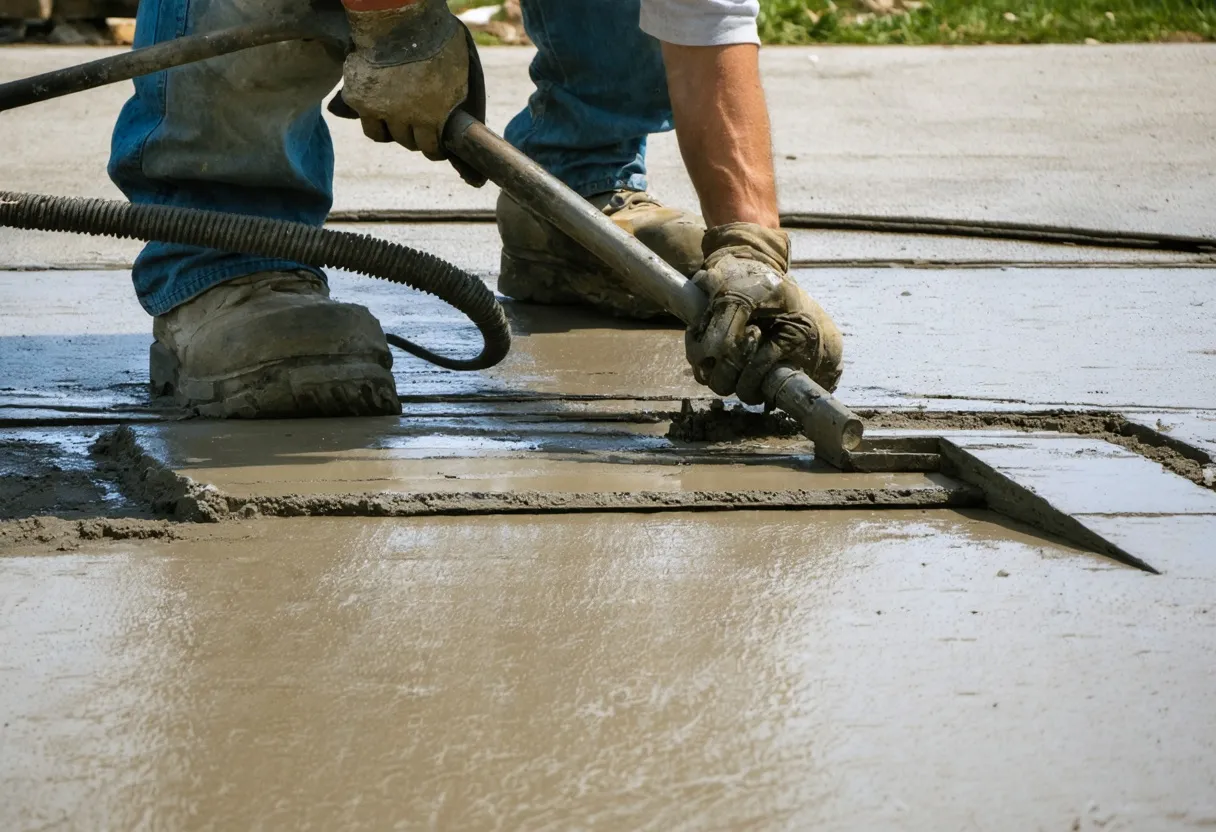
Most pages that come up for "stamped concrete tuscaloosa al" read like they were written for anywhere — the same five paragraphs about flagstone patterns and "factors that affect price," with no mention of what's actually under the slab. In Tuscaloosa County that's a problem, because the ground here isn't neutral. Clay-heavy soil under Forest Lake, Alberta City, Northport, Cottondale, and Vance swells when it's saturated and pulls back hard when it dries, and this area sees roughly 55 inches of rain a year to keep that cycle going. A stamped patio or driveway poured without accounting for that movement doesn't fail because the pattern was wrong — it fails because the ground under it moved and nobody engineered for it.
This page is built around that reality instead of around generic pricing-factor bullet points. You'll find how we evaluate your specific soil and site before quoting anything, what an itemized written estimate actually breaks down into, what our written warranty covers in plain terms, and which stamp patterns and color families genuinely hold up against West Alabama's clay runoff, humidity, and summer heat. If you're comparing quotes for a stamped concrete patio, a stamped driveway, or matching new decorative concrete to an existing surface, the questions below are the ones worth asking before anyone shows up with a mixer truck.
The Soil Problem Under Every Tuscaloosa Stamped Patio
Stamped concrete is only as good as what's beneath it. The decorative layer — pattern, integral color, release agent, sealer — sits on top of a slab, and that slab sits on a compacted base, and that base sits on native soil. In most of Tuscaloosa County, that native soil has meaningful clay content, and clay is a moving target. It absorbs water during heavy spring storms and long humid stretches, expands, then contracts hard as it dries out in late summer. A subgrade that isn't excavated to proper depth and rebuilt with a compacted aggregate base will telegraph that movement straight up through the slab — as random cracking, as uneven settling at one corner of a patio, or as a driveway edge that slowly drops relative to the garage slab it meets.
Why this matters more here than in a generic pricing guide
A lot of decorative concrete content treats subgrade prep as one line item among many. On clay-heavy Tuscaloosa-area lots, it's the line item that determines whether your investment lasts. We treat soil and drainage assessment as the starting point of every stamped concrete conversation, not a footnote buried in the estimate:
- Excavation depth is set by what's actually there. A lot in Alberta City with heavier clay content needs a different excavation and base depth than a sandier pocket out toward Vance — we don't apply one spec to every address.
- Compacted aggregate base replaces the guesswork. Native clay isn't left to support the slab directly; it's built up with a properly compacted base material sized to the load the slab will carry.
- Grading and drainage get corrected, not just noted. Water needs a path away from the new slab and away from the foundation next to it — on flat or low-lying lots near Forest Lake this is often the difference between a patio that stays flat and one that starts pooling within a season or two.
- Control joints are placed by engineering logic, not habit. Joint spacing accounts for slab size, shape, and the soil movement it's likely to see, so shrinkage cracking lands on a planned line instead of through the middle of a stamped stone pattern.
None of this shows up in a photo of the finished pattern, which is exactly why it gets skipped by contractors racing to the lowest bid. It's also exactly what we walk you through, in writing, before a shovel touches your yard.
How We Price and Build a Stamped Concrete Project — Line by Line
We walk your specific lot, check drainage and existing grade, and assess how the soil on your property is likely to behave before any number gets discussed.
You get a line-by-line written breakdown covering excavation, base material, reinforcement, concrete mix, coloring and stamping labor, and sealing — not a single lump figure with no explanation behind it.
What's covered, for how long, and what happens if cracking or settling occurs within that period is put in writing up front, not promised verbally and left ambiguous.
Excavation, compacted aggregate base, control-joint layout, and steel reinforcement are installed to match your soil conditions and the slab's intended use, whether that's foot traffic or vehicle loading.
Color and pattern work happens within concrete's narrow working window, and the finished slab is sealed and walked through with you so you know the maintenance schedule going forward.
What a Clay-Engineered Stamped Concrete Estimate Includes
Stamped Concrete Questions Tuscaloosa Homeowners Actually Ask
The biggest swing factor is usually what's happening below the surface, not the stamp pattern. A quote that skips proper excavation depth, aggregate base, or reinforcement sized to your soil will come in lower — and is far more likely to crack or settle within a few seasons. Ask any contractor you're comparing to itemize excavation, base, and reinforcement separately so you can see what you're actually paying for.
Yes. Clay-heavy soil expands and contracts as it wets and dries, and with roughly 55 inches of rain a year that cycle repeats constantly. A slab poured on properly excavated and compacted base handles that movement well; a slab poured on unprepared native clay is far more likely to crack unevenly or settle at the edges within the first few years.
That depends on the contractor, which is exactly why it needs to be in writing before you sign anything — not a verbal "we stand behind our work." Ask specifically what's covered, for how long, and what the remedy is if cracking or settling happens within that period. We review these terms with you in writing as part of the estimate, before any deposit changes hands.
Not always a formal lab test, but a proper site evaluation of the specific soil and drainage on your lot is non-negotiable given how much clay content varies across the Tuscaloosa area, from Forest Lake to Cottondale to Northport. Skipping that step is how contractors end up applying a one-size-fits-all spec to ground conditions that don't support it.
It can be matched closely by pairing stamp pattern, base color, and release color, though rarely perfectly if the existing concrete has weathered over several seasons. Bringing a sample or photo of your existing surface to the site evaluation lets us test combinations before committing to a pour, and the two areas typically weather closer together over time.
Yes — decorative work adds labor and material layers a plain broom-finish slab doesn't need: integral color, color hardener, release agent, stamping labor, and a protective sealer, on top of the same excavation and reinforcement work every slab needs on clay soil here. An itemized estimate should show you each of those layers separately rather than folding them into one number.
Get It in Writing Before the Truck Shows Up
An itemized estimate and written warranty terms cost you nothing to ask for and take five minutes to review. If a contractor can't hand you either one before you sign, that's the answer you need before you commit a Tuscaloosa driveway or patio to their crew.
Stamp Patterns and Colors That Hold Up Against Tuscaloosa Weather
Pattern and color choice isn't purely aesthetic once you factor in West Alabama's sun, humidity, and red-clay runoff. A few families come up repeatedly in this market for practical reasons as much as looks:
- Ashlar slate and fractured-earth patterns use irregular, organic joint lines that hide minor surface variation and hairline settling far better than a rigid geometric layout does once a slab has a few seasons of heat-cycling behind it.
- Running-bond and herringbone brick pair naturally with the brick architecture common in older Tuscaloosa and Alberta City neighborhoods, and show up often on front walkways and porch extensions.
- Wood-plank stamps give pool decks and covered patios a boardwalk look without the rot, splintering, or refinishing cycle real wood goes through in a climate this humid.
- Cobblestone and Belgian block textures read heavier and more formal, which is why they show up more on driveways and entry courts than on patios.
Color choices that actually resist this climate
Earth-tone bases — tans, buckskins, terracottas — with a charcoal or walnut release for contrast in the joints have become the practical default locally, and it's not just a style trend. Those tones hide pollen film and red-clay staining far better than stark grays or whites do, and they show tool marks and years of outdoor wear less obviously. Lighter base colors also stay noticeably cooler underfoot through a Tuscaloosa summer, which matters directly for pool decks and uncovered patios where bare feet are on the surface from April through September. Two-tone or antiqued finishes — a base color with a darker accent hand-applied at edges and joints — add depth and mask fine surface marks as the slab ages, which is a durability decision as much as a design one. Whatever combination you're leaning toward, ask to see it on a physical sample outdoors rather than on a screen; color reads noticeably different under Alabama sunlight than it does in a showroom.
Request a Free Quote
No obligation, no pressure, just a clear price for your project.
Get Your Written Quote
See the price before you decide anything.